


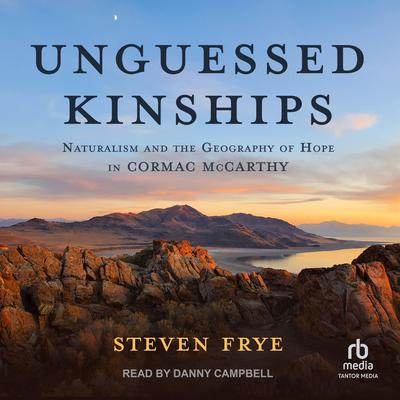

Unguessed Kinships: Naturalism and the Geography of Hope in Cormac McCarthy
By Steven Frye
Read by Danny Campbell
-
2 Formats: CD
-
2 Formats: MP3 CD
-
Regular Price: $45.99
Special Price $36.79
ISBN: 9798212935180
Free shipping on US orders over $99
-
Regular Price: $45.95
Special Price $36.76
ISBN: 9798212935197
Free shipping on US orders over $99
It took six novels and nearly thirty years for Cormac McCarthy to find commercial success with All the Pretty Horses, followed by major prizes, more bestsellers, and Hollywood adaptations of his work. Those successes, though, have obscured McCarthy's commitment to an older form of literary expression: naturalism. McCarthy's work tends to darker themes: violence, brutality, the cruel indifference of nature, themes which would not be out of place in the writing of Jack London or Stephen Crane. But literary naturalism is more than the oversimplified Darwinism that many think of. Nature may be red in tooth and claw, and humans are part of nature, but the humanity depicted in naturalist literature is capable of love, selflessness, and spirituality, as well. In Unguessed Kinships, Steven Frye illuminates all these dimensions of McCarthy's work. In his novels and plays, McCarthy engages both explicitly and obliquely with the project of manifest destiny, in the western drama Blood Meridian, the Tennessee Valley Authority-era Tennessee novels, and the atomic frontier of Alamogordo in Cities of the Plain. McCarthy's concerns are deeply religious and philosophical, drawing on ancient Greek philosophy, Gnosticism, and Nietzsche, among other sources. Frye argues for McCarthy not merely as a naturalist writer but as a naturalist in the most expansive sense.
Learn MoreSummary
Summary
It took six novels and nearly thirty years for Cormac McCarthy to find commercial success with All the Pretty Horses, followed by major prizes, more bestsellers, and Hollywood adaptations of his work. Those successes, though, have obscured McCarthy's commitment to an older form of literary expression: naturalism. McCarthy's work tends to darker themes: violence, brutality, the cruel indifference of nature, themes which would not be out of place in the writing of Jack London or Stephen Crane. But literary naturalism is more than the oversimplified Darwinism that many think of. Nature may be red in tooth and claw, and humans are part of nature, but the humanity depicted in naturalist literature is capable of love, selflessness, and spirituality, as well.In Unguessed Kinships, Steven Frye illuminates all these dimensions of McCarthy's work. In his novels and plays, McCarthy engages both explicitly and obliquely with the project of manifest destiny, in the western drama Blood Meridian, the Tennessee Valley Authority-era Tennessee novels, and the atomic frontier of Alamogordo in Cities of the Plain. McCarthy's concerns are deeply religious and philosophical, drawing on ancient Greek philosophy, Gnosticism, and Nietzsche, among other sources. Frye argues for McCarthy not merely as a naturalist writer but as a naturalist in the most expansive sense.
Author
Author Bio: Steven Frye

Titles by Author
Details
Details
| Available Formats : | CD, MP3 CD |
| Category: | Nonfiction/Literary Collections |
| Runtime: | 7.85 |
| Audience: | Adult |
| Language: | English |
To listen to this title you will need our latest app
Due to publishing rights this title requires DRM and can only be listened to in the Audio Editions app